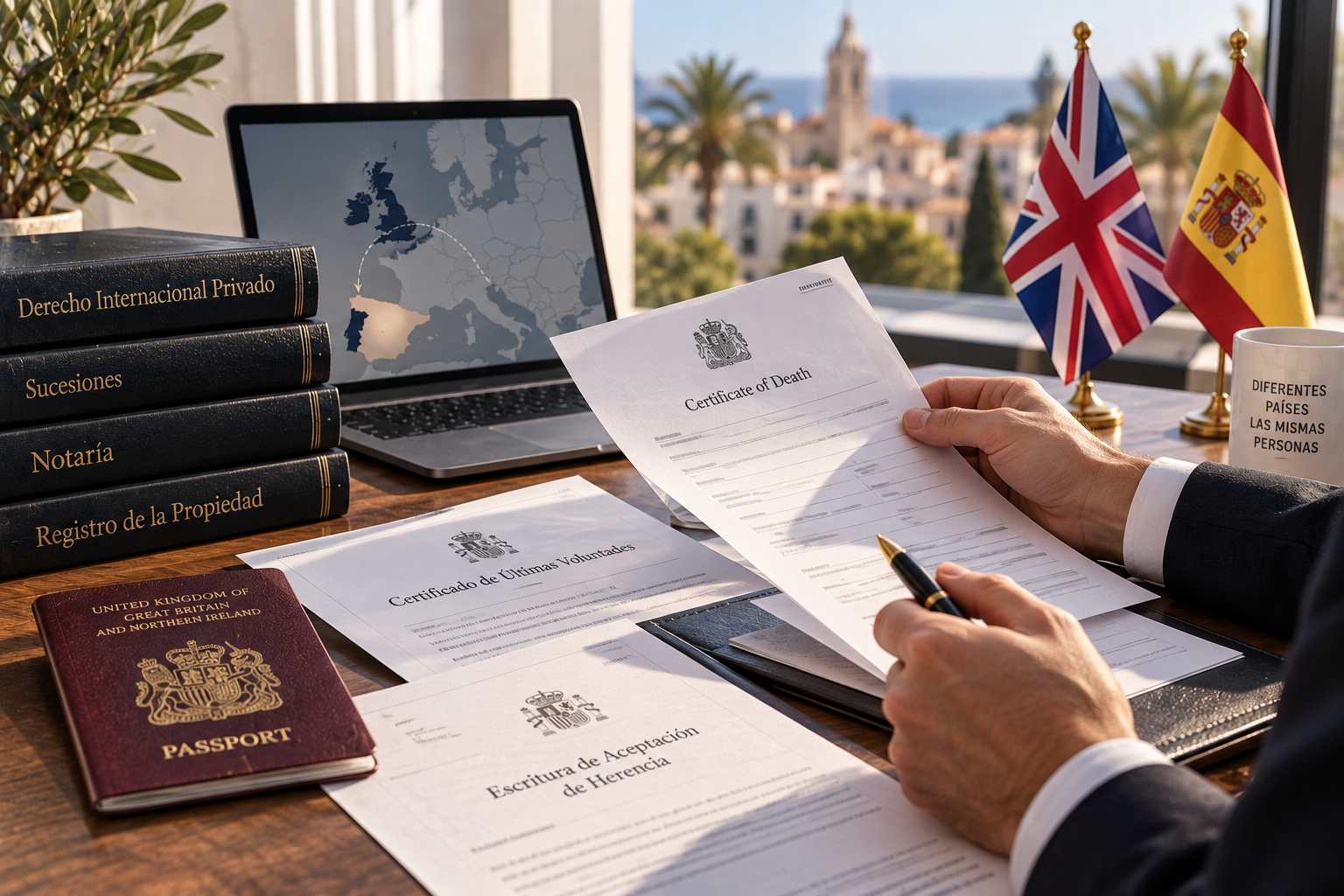
International inheritance without a will: how we resolved the estate of a British national with property in Spain
A real international intestate succession case involving the United Kingdom and Spain, with several properties located in Spain.
International inheritances can become legally complex when the deceased had links to several countries. The difficulty increases considerably when there is no will either in Spain or in the country of origin.
We recently resolved an estate of this kind at the firm: a British national died unexpectedly without a will, leaving several properties in Spain.
He was a young man, around 40 years old. He was married, had no children and died in the United Kingdom.
From one day to the next, his wife was faced not only with the loss of her husband, but also with a difficult legal question:
Who inherits, and how is an international inheritance handled in Spain when a British national dies without a will and owns property in Spain?
Answering that question correctly was the starting point for the entire case.
The problem: an inheritance between the United Kingdom and Spain without a will
When a person dies without having made a will, we cannot simply assume who will inherit their assets.
And when international elements are involved, we cannot simply assume that, because the properties are located in Spain, the entire succession will automatically be governed by Spanish law.
Before a single property could be transferred, the succession had to be legally reconstructed.
In our case, several elements required particularly careful analysis:
- the deceased was a British national;
- he had died in the United Kingdom;
- he had not made a will;
- he owned several properties in Spain;
- he was married;
- he had no children;
- other relatives had an interest in the succession.
Therefore, the first issue was not to go to the Land Registry to change ownership of the properties.
The first issue was much more important:
to determine legally who was entitled to inherit.
Owning property in Spain does not automatically mean that Spanish law applies
This is one of the mistakes we frequently encounter in international succession matters.
The location of a property in Spain is extremely important for certain formalities, but it does not by itself determine which law governs the succession.
In an international inheritance, it is necessary to analyse, among other matters, the deceased's nationality, habitual residence at the time of death, family circumstances, whether any testamentary dispositions exist, and the applicable rules of private international law.
And when the deceased is British, the analysis requires particular care because different legal systems must be coordinated.
For this reason, before starting notarial, registry or tax procedures in Spain, it is essential to determine correctly which law applies to the succession and who the heirs are under that law.
The spouse should not assume that they will automatically inherit all the assets
Another particularly sensitive issue in this case was the position of the wife.
When a married person dies without children, it is common to think:
"If there are no children, his wife will inherit everything."
Legally, we cannot work on that assumption.
The absence of descendants does not necessarily mean that other people cannot have inheritance rights.
In our case, there were other relatives who believed that they should take part in the inheritance.
It was therefore necessary to examine the complete family situation before determining how the succession should be structured.
This is one of the reasons why I advise against beginning to distribute assets, signing family agreements or taking action concerning the properties before knowing exactly who the heirs are and what rights each person has.
How we approached the inheritance
In an international succession of this kind, there is no single document that resolves the entire case.
The solution requires building the inheritance legally, step by step.
In our case, we began by analysing the deceased's personal and financial circumstances and confirming that there was no will.
It was then necessary to determine which rules governed the succession and who legally qualified as heirs.
At the same time, we analysed the properties located in Spain, their ownership and the documentation required to formalise the succession in relation to those assets.
We also had to coordinate documentation from the United Kingdom with Spanish legal, notarial, registry and tax requirements.
Only once the succession issue had been properly resolved was it possible to proceed safely with the allocation and regularisation of the properties in Spain.
The real work in an international inheritance takes place before the deed is signed
This case illustrates something that I consider particularly important.
An international inheritance is not simply a matter of preparing documents to sign a deed before a notary.
The essential legal work takes place beforehand.
The case must be studied, the applicable law determined, the heirs identified, the foreign documentation analysed and the necessary legal instruments chosen so that a succession arising in another country can correctly produce its effects in relation to assets located in Spain.
When that preliminary analysis is done properly, the notary and the Land Registry are the culmination of the work.
When it is not, requests for additional information, unnecessary documentation, delays, costs and, in more complicated cases, disputes between people who believe they have rights to the inheritance may arise.
We were ultimately able to resolve the succession and regularise the properties in Spain
After carrying out all of this legal and documentary work, we were able to structure the succession correctly and formalise the inheritance of the properties in Spain.
The result resolved a situation that initially raised many questions: an unexpected death, no will at all, assets in Spain, foreign documentation and several relatives potentially involved.
But the case also highlighted an especially important lesson.
Many of the difficulties we had to resolve after the death could have been avoided with proper succession planning.
What would have changed if there had been a will?
Probably a great deal.
A foreign national who owns property in Spain should seriously consider how they want to organise their succession.
It is not simply a matter of "making a will".
It is about analysing which law may govern the future succession, what consequences this may have for a spouse and children, how assets located in different countries should be coordinated, and how the future process can be made easier for the heirs.
In another article from the firm, I explain precisely why it is important for foreign nationals with assets in Spain to plan their will and succession properly.
Do you need to deal with the Spanish inheritance of a foreign relative?
If a relative has died in the United Kingdom or another country and owned a house, apartment, land or other assets in Spain, it is not advisable to begin carrying out isolated procedures.
The entire succession should be analysed first.
At SPA Abogada, we handle international inheritances involving assets in Spain, including intestate successions and matters requiring the coordination of documents and procedures between Spain and the deceased's country of origin.
We can handle the procedure in Spain and coordinate the different steps required until the assets have been allocated and regularised.
If you need to resolve an international inheritance involving property in Spain, you can contact the firm so that we can review your case.
Frequently asked questions about British inheritances involving property in Spain
What happens if a British national dies without a will and owns a house in Spain?
It will be necessary to determine which law governs the succession, who the heirs are and what documentation can prove their rights before the property can be formally transferred in Spain.
Does Spanish law always apply because the property is in Spain?
This should not be assumed. The law applicable to an international succession must be determined in accordance with the relevant rules of private international law.
Does the wife inherit everything if the deceased had no children?
This cannot be stated as a general rule. It will depend on the applicable law and on the deceased's family and succession circumstances.
Is it necessary to travel to Spain to deal with the inheritance?
Not necessarily. Depending on the case, many steps can be arranged through appropriate representation and powers of attorney.
Can a Spanish property be sold before the inheritance has been resolved?
While the property remains part of the estate and the succession has not been properly regularised, there may be significant obstacles to disposing of it. The inheritance should therefore be properly analysed and dealt with first.
Is it advisable for a British national with property in Spain to make a will?
Succession planning is particularly advisable when assets are located in different countries. The will should be prepared taking into account the person's specific personal, family and financial circumstances and, where appropriate, coordinated with any succession arrangements already in place in another country.