I want to divorce in Spain but I got married in another country
What you should consider if you married abroad and want to get divorced in Spain.
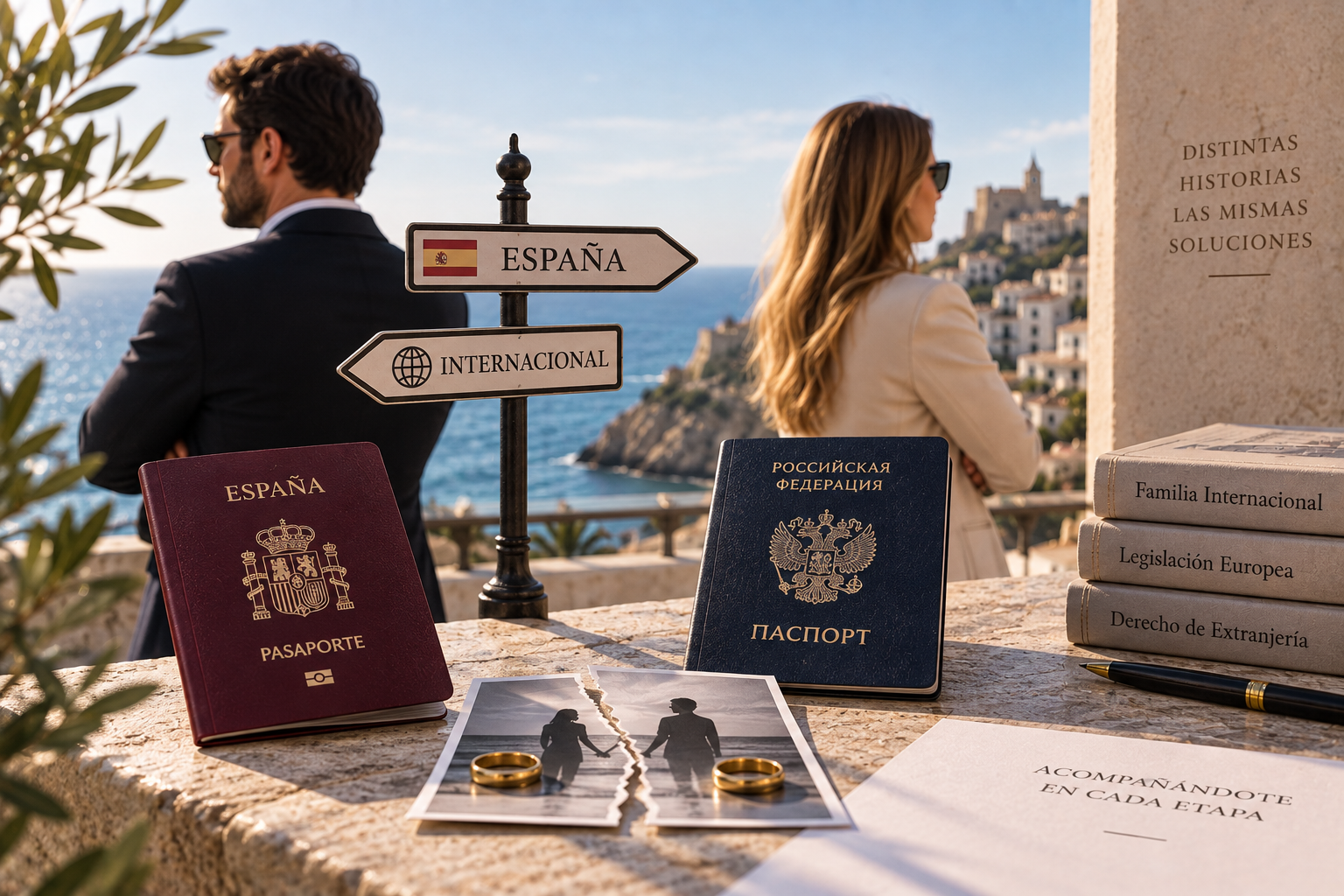
A fairly common question is: I want to divorce in Spain, but I got married in another country. Can I do it here?
The fact that the marriage took place abroad does not in itself prevent the divorce from being handled in Spain.
What matters is analysing the specific circumstances of the marriage: where the spouses currently live, where the children live if there are any, what documentation exists and what connection the couple has with Spain.
That is why, when we talk about an international divorce, the first thing is not simply to look at the country where the wedding took place.
The whole case must be examined.
Can I get divorced in Spain if I got married in another country?
It may be possible.
A couple who married, for example, in the United Kingdom, France, Morocco, Colombia, Argentina or any other country does not necessarily have to divorce there.
In an international divorce, the first step is to determine whether the Spanish courts have jurisdiction to deal with the proceedings.
Relevant factors may include:
- where the spouses currently live;
- where they have had their habitual residence;
- where the other spouse lives;
- whether there are minor children;
- where those children live;
- the spouses' nationalities;
- the specific circumstances of the marriage.
The correct question is therefore not simply:
"Where did I get married?"
But rather:
"Can I deal with my divorce in Spain taking my current situation into account?"
Do I first have to register my marriage in Spain?
This is another question that frequently arises.
When the marriage took place abroad, it is necessary to check what documentation proves the marriage and its current status.
Not every case is the same.
Before starting proceedings, it is advisable to check whether the marriage is registered in Spain, what marriage certificate is available and whether the foreign documentation can be used directly or requires any additional formalities.
For this reason, we do not recommend beginning a divorce by requesting documents at random.
We first review the situation and then determine exactly what documentation will be required.
What documents might I need?
The documentation will depend on the case, but it will generally be necessary to prove both the existence of the marriage and the identity and circumstances of the spouses.
Documents that may be required include:
- marriage certificate;
- identity documents or passports;
- documents relating to domicile or residence;
- birth certificates of the children, if any;
- financial documentation if maintenance or financial matters need to be regulated;
- documentation relating to jointly held assets;
- foreign documents connected with the marriage.
When a document has been issued in another country, it may be necessary to check whether it needs to be translated or must meet certain requirements before it can be used in Spain.
The specific documentation will always depend on the country of origin and the circumstances of the proceedings.
Divorce by mutual agreement or contested divorce
As with other divorces, international proceedings may be handled by mutual agreement or there may be disagreement between the spouses.
Divorce by mutual agreement
If both parties agree to divorce and can also agree on the consequences of the separation, the procedure is usually simpler.
The agreement will need to address the matters that apply to the family's circumstances.
For example:
- children;
- custody;
- contact and visitation arrangements;
- child maintenance;
- use of the family home;
- financial matters;
- division or treatment of certain assets.
Not all of these issues will arise in every divorce.
It depends on each marriage.
Contested divorce
If one spouse does not agree with the proposed arrangements or there is conflict concerning children, the home, maintenance or assets, the proceedings may become contested.
In that situation, correctly determining which courts have jurisdiction and which rules apply becomes even more important.
When one spouse lives in another country, additional difficulties may also arise in relation to communications and documentation.
What if my spouse lives in another country?
The fact that the other spouse lives outside Spain does not automatically mean that it is impossible to divorce here.
But it can make the proceedings more complex.
It will be necessary to know exactly where the other person lives and to analyse how the proceedings should be conducted.
This is particularly important when the other spouse:
- lives permanently in another country;
- does not want to cooperate;
- does not respond;
- does not agree to the divorce;
- has children living outside Spain.
In these cases, it is important to prepare the proceedings correctly from the outset.
What happens if we have children?
When there are children, divorce is no longer solely a matter between two adults.
The measures affecting them will have to be regulated.
These may include:
- care and custody;
- contact and visitation arrangements;
- child maintenance;
- place of residence;
- important decisions concerning the children.
In international divorces there is also a particularly important question:
Where do the children habitually live?
The rules of a purely domestic Spanish divorce should not automatically be applied to a family whose life is spread across different countries.
Each situation must be considered individually.
And what happens to the assets?
Divorce and the couple's financial situation are closely connected, but they cannot always be resolved with a generic answer.
There may be:
- homes in Spain;
- properties in another country;
- bank accounts;
- mortgages;
- businesses;
- assets acquired before the marriage;
- assets acquired during the marriage.
It will also be necessary to determine which matrimonial property regime applies and how the assets should be treated in the specific case.
For this reason, if there are properties or assets in several countries, it is important to identify them before finalising any agreement.
Separation and divorce are not the same
Although the terms are often used as if they meant the same thing, separation and divorce are not exactly the same.
The main difference is simple:
With legal separation, married life together ends, but the marriage bond itself is not dissolved.
With divorce, the marriage bond ends.
This means that a divorced person can marry again, while a person who is only legally separated remains married.
It is currently not necessary to separate first before later applying for a divorce.
If the decision is to end the marriage permanently, divorce can be sought directly.
What mistakes should be avoided?
In international divorces, we consider it particularly important to avoid several assumptions.
Assuming that you must divorce in the country where the wedding took place
The country where the marriage was celebrated is relevant, but it is not the only factor that needs to be considered.
Preparing documents without knowing whether they can be used in Spain
A foreign certificate may have to meet certain requirements before it can be used.
It is better to know first exactly what is needed.
Failing to disclose assets in other countries
If there are properties, accounts or other assets outside Spain, they should be identified from the beginning.
Failing to explain where the children actually live
In an international divorce, this information can be particularly important.
Signing agreements without considering their consequences
The fact that both spouses want a quick divorce does not mean that any agreement should be accepted.
Issues such as children, housing, maintenance and assets should be carefully reviewed before anything is signed.
What should I do if I married abroad and now want to divorce in Spain?
The first step is to gather the basic information about the marriage.
Before starting proceedings, it is useful to know:
- in which country the marriage took place;
- where each spouse currently lives;
- how long they have lived there;
- whether there are children and where they live;
- what marriage documentation exists;
- whether there are properties or assets in Spain or other countries;
- whether both spouses agree to divorce.
With this information, it is much easier to analyse how the proceedings should be approached.
Conclusion
Getting married in another country does not necessarily mean that you have to get divorced there.
In certain cases, the divorce may be handled in Spain, but it is first necessary to determine whether the Spanish courts can deal with the matter and what documentation will be required.
If there are also children, properties in different countries or one spouse lives abroad, the proceedings require even greater care.
The important thing is not to begin the divorce based solely on the place where the wedding took place.
In an international divorce, the entire situation must be examined.
Frequently asked questions
Can I get divorced in Spain if I got married abroad?
It may be possible. The circumstances of the marriage must be analysed to determine whether the proceedings can be brought before the Spanish courts.
Does the country where I got married matter?
It may be relevant, but it is not the only factor that must be taken into account.
Do I need the foreign marriage certificate?
It will normally be necessary to prove the existence of the marriage. The specific document required and the formalities it must meet will need to be checked.
Can I get divorced if my husband or wife lives outside Spain?
It may be possible, although living in different countries can add complexity to the proceedings.
What happens if we have children?
The arrangements affecting them will have to be regulated, with particular attention to where they habitually live.
Is a divorce by mutual agreement better?
If both spouses can reach agreement on the necessary issues, the procedure may be simpler than a contested divorce.
Note: This article is for information purposes only. International divorces can vary considerably depending on the country, the spouses' residence, whether there are children and other circumstances of the marriage.